 |
 |
| Mumtaz Qadri was hailed as a hero by some Islamist groups |
 |
| Protests took place on Monday in Peshawar and other Pakistani cities |
 |
| This road into Islamabad was blocked by Qadri supporters on Monday |
What are Pakistan's blasphemy laws?
But the rallies in Karachi, Lahore and Islamabad were mostly peaceful. Demonstrators burned tyres and chanted slogans, as well blocking some roads into Islamabad.
Heightened security: Ilyas Khan, BBC News, at the scene in Islamabad
Islamabad is unusually quiet this morning. Schools are shut, most markets are likely to remain closed, and lawyers are observing a strike. Authorities have placed shipping containers on roads to seal the Red Zone, where government buildings are located.
 Neighbouring Rawalpindi, where
the burial will take place, is largely off-limits for commuters,
especially areas around the venue. There is heightened security
in all major cities and towns. The authorities in Karachi have banned
pillion-riding on motorbikes until Friday to prevent drive-by attacks.
Neighbouring Rawalpindi, where
the burial will take place, is largely off-limits for commuters,
especially areas around the venue. There is heightened security
in all major cities and towns. The authorities in Karachi have banned
pillion-riding on motorbikes until Friday to prevent drive-by attacks.Large crowds are expected to pour in for the funeral. The tempo is being built up by religious groups, including the mainstream Jamaat-e-Islami party which termed Monday, the day of Qadri's hanging, as the "black day" and announced daily protests until Friday.
But fear of violence is not as acute as one would have expected some years ago. Monday's protests did not attract large crowds and protesters did not show a willingness to take on the security personnel manning the cordons.
Also, Pakistan's often cacophonic TV news channels have been uncharacteristically restrained, apparently following firm official advice. This has kept public anxiety at a lower level.
Qadri was executed at 04:30 local time (23:30 GMT) at Adiala jail in Rawalpindi on Monday.
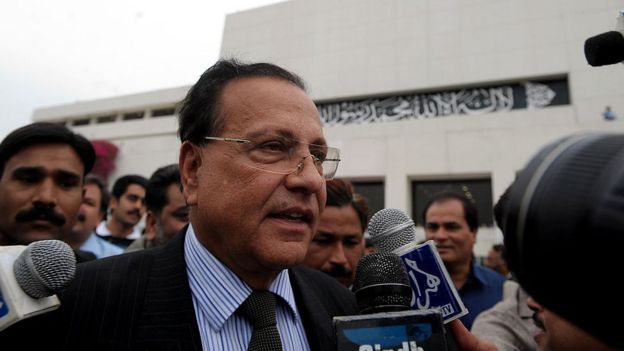
He had trained as an elite police commando and was assigned to Salman Taseer as his bodyguard. Qadri shot the politician 28 times at an Islamabad market in January 2011 and was sentenced to death later that year.
He claimed it was his religious duty to kill the minister, who was an outspoken critic of Pakistan's harsh blasphemy laws and supported liberal reforms. Pakistan has seen Islamist groups grow in influence in recent years and several high-profile blasphemy cases.
Blasphemy is an extremely sensitive issue in Pakistan and critics argue that blasphemy laws are often misused to settle personal scores and unfairly target minorities.
No comments:
Post a Comment