South Africa's universities have
faced protests and disruption, linked by a strong common thread. A place
at a public university is now unaffordable for a large majority of
potential students.
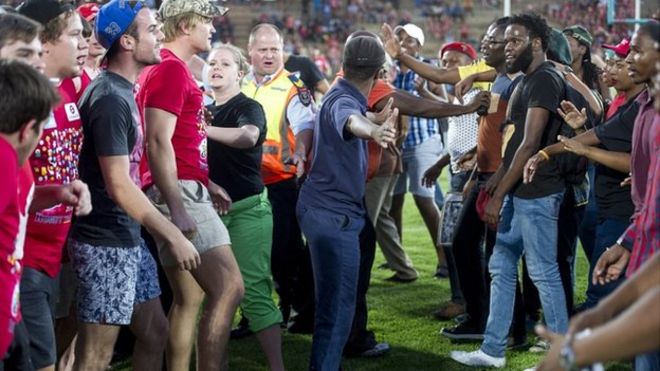 |
| Students and spectators clashed at a university rugby match in Bloemfontein |
 |
| Students at Tshwane University of Technology were sent home after violent protests |
 |
| Buildings were burned in a protest at North-West University in Mafikeng |
 |
| Universities across South Africa have faced disputes and student protests |
The common thread is inequality and its consequences for student funding. South Africa is now one of the most unequal countries in the world and has a high and growing level of unemployment.
Average household income is about R75,000 a year (roughly £3,500), and about 70% of South Africans qualify for free state housing because they earn so little. Wealth, and the advantages in housing, healthcare and education that come with it, is sharply concentrated in the top two deciles of the population.
These economic circumstances have a profound effect on access to higher education. The odds are heavily stacked against those from low income families because the quality of public schooling is highly variable.
Those that qualify to apply for a university place then encounter formidable financial barriers. Very poor students may receive a bursary but this will not meet their full costs.
Those from slightly better-off families find themselves in a trap, earning too much to qualify for state support, but far too little to be able to afford fees and accommodation costs.
No comments:
Post a Comment