A human-carrying drone has been given approval for test flights in Nevada, the first of its kind in the United States.
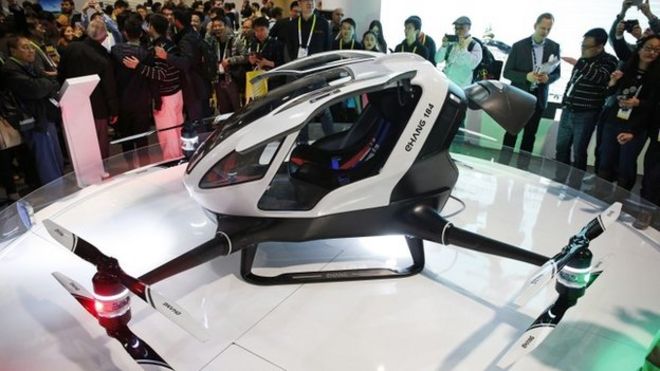 |
| The personal minicopter was shown off at the Consumer Electronics Show in Las Vegas |
 |
 |
The prototype drone is over 4ft (1.2m) tall, weighs 440lb (200kg) and has eight propellers. It can carry a single passenger for 23 minutes at 60mph (96km/h).
Passengers enter their destination on a 12in (30cm) touchscreen in front of their seat, and the drone's on-board computer works out the best route.
There is no passenger over-ride function, meaning the user cannot take control in an emergency. In the event of a malfunction, the drone would land in the nearest available area. It is likely to sell for between £140,000 ($200,000) and £200,000.
Big leap
Regulation of commercial drones has proved tricky in both the US and Europe, and some doubt passenger drones will ever get off the ground. "It feels like it is a long way off," said Douglas McNeill, a senior analyst at consultancy Macquarie."Drones will first have to prove their worth in less people-facing roles such as deliveries of small cargo.
"The other question is whether people will be willing to fly in a pilotless aircraft, and that seems like a big leap.
"People are sensitive to reduced journey times, and if drones could do that it would be a big plus - but I'm not sure that they can. "Consumers are led by what regulators say are safe. And if they say these drones are safe, people might be more willing."
Dr Mirko Kovac, director of the Aerial Robotics Lab at Imperial College London, said: "Passenger drones have huge potential. "They can decrease congestion, offer flights in challenging environments and in developing countries where the road infrastructure is not as developed.
"We don't even think about large aircraft flying over large cities on autopilot. "Yet people are afraid of drones, some of which may use similar robotic technology. "I think society will overcome this once the technology is more proven."
No comments:
Post a Comment