 |
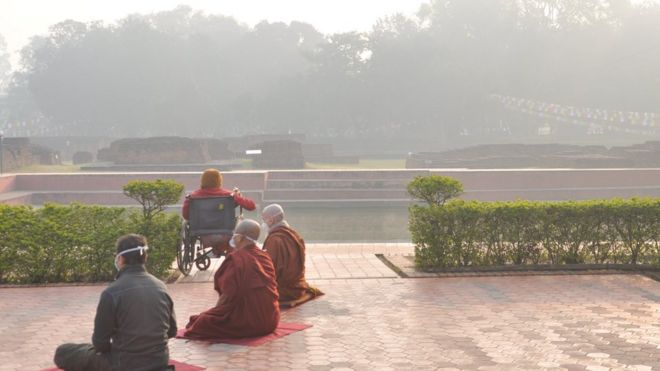
| Monks put on masks to protect themselves from pollution in Lumbini |
The historic site of Buddha's
birthplace in Nepal faces a serious threat from air pollution,
scientists and officials have warned.
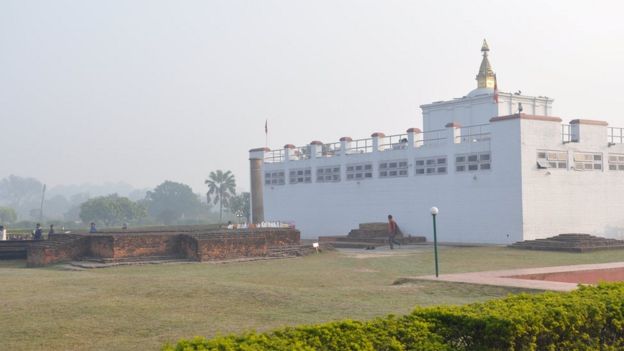 |
| Scientific studies have warned that rising air pollution threatens the historic artefacts of Buddha's birthplace |
The reading for the neighbouring town of Chitwan was 113.32 and the capital, Kathmandu, which is known for its high pollution levels, was at 109.82.
The World Health Organization (WHO) safe limit for the pollutant is 25 micrograms per cubic metre and the Nepal government has set the national standard at 40.
Scientific studies have also highlighted the increasing levels of pollution in and around the historic site.
"The combined effect of trans-boundary transport from the pollution rich Indo-Gangetic Plain region and trapped local industrial pollution due to temperature inversion is responsible for severe winter pollution," says a study done by the Indian Institute of Tropical Meteorology in collaboration with the WHO.
"For other seasons, local emissions are largely responsible for bad air quality." It found that levels of PM 2.5 fine particles, which can enter human blood vessels, were more than 10 times above the WHO safe limit.
Another study conducted by the IUCN and UNESCO found that the pollution had begun to threaten the Lumbini World Heritage site.
"The expansion of the carbon emission industries within the Lumbini Protected Zone has caused several problems such as threats to biodiversity, health hazards to local residents, archaeological properties, social and cultural values."