 |
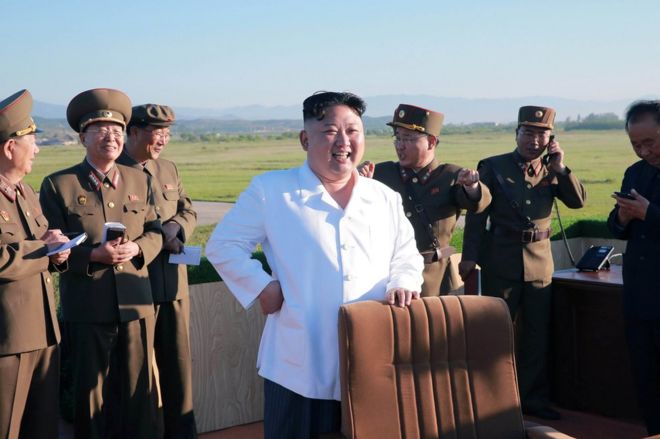
| The launch comes a day after reports that North Korea's leader Kim Jong-un supervised an anti-aircraft system test |
North Korea has fired a short-range ballistic missile, the third apparently successful test in as many weeks.
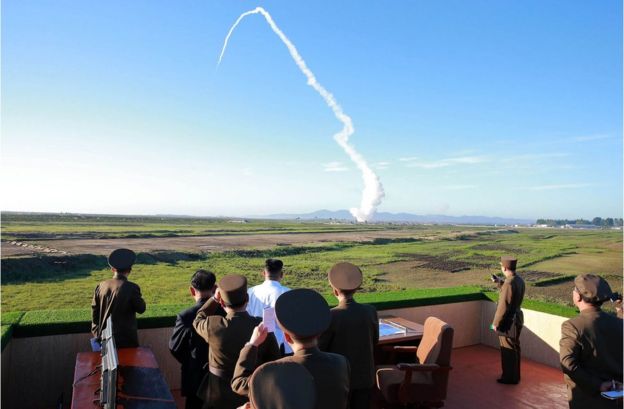 |
| Kim Jong-un (in white shirt) reportedly watched the anti-aircraft system test with top North Korean officials |
- Have North Korea's missile tests paid off?
- How advanced is North Korea's nuclear programme?
- Trump fears 'major major' conflict with North Korea
- North Korea's missile programme
The US Pacific Command said the missile was launched from Wonsan in North Korea and flew for about six minutes before landing.
Japan's chief cabinet secretary Yoshihide Suga told reporters that the missile landed in an area between Japan's Sado and Oki islands, in their exclusive economic zone.
A spokesman for South Korea's military said the missile reached an altitude of 120km, and "an analysis is under way on the specific number" of missiles fired, indicating that more than one could have been launched.
The launch comes a day after North Korea's state media reported the test of a new anti-aircraft weapon system, and released pictures of leader Kim Jong-un watching the test.
North Korea has a large stockpile of short-range Scud missiles developed by the Soviet Union. Modified versions of the Scud missiles can have a range of 1,000km.
The previous two launches were of medium to long range missiles, both of which the North claimed as "successful" tests.
The first of those launches was hailed by Pyongyang as a new type of rocket capable of carrying a nuclear warhead - it was a demonstration of the North's longest-range nuclear-capable weapon yet.
Pyongyang has been testing its missiles at an unprecedented pace and experts believe it is steadily edging towards the test of an intercontinental ballistic missile capable of hitting the mainland United States.
North Korea says its weapons programme is necessary to counter US aggression.