 |
|
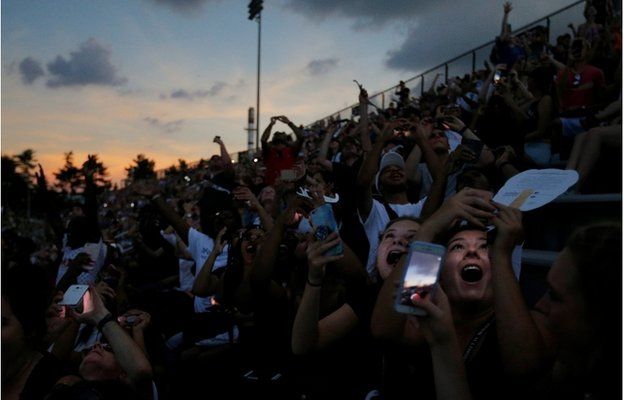
Those who went to Carbondale were not disapointed
|
A total solar eclipse has wowed the US.
A
huge shadow cast by the Moon as it passed in front of the Sun swept
across the nation, from Oregon in the west to South Carolina in the
east.
 |
|
US President Donald Trump and First Lady Melania Trump saw a partial eclipse in Washington DC
|
Millions of people moved to get into the path of darkness, putting on their protective glasses to gaze at the sky in wonder.
 |
|
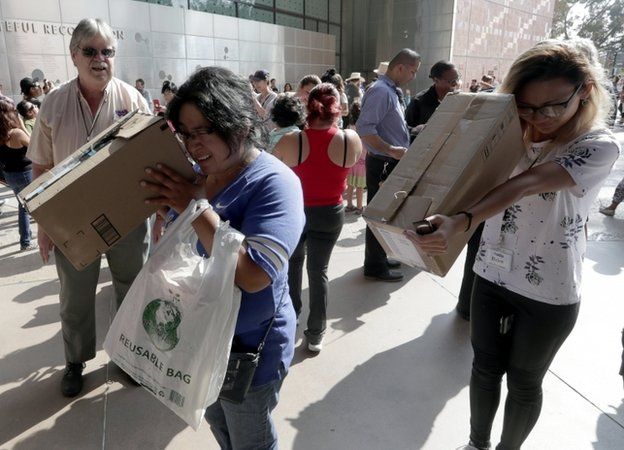
Using a "pinhole camera" was the safest way to view the Sun and Moon action
|
 |
|
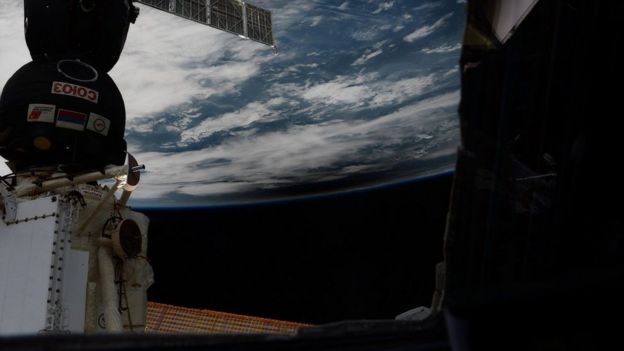
Space station astronaut Paolo Nespoli pictured the Moon's shadow from orbit
|
It was the first
total solar eclipse visible from America's lower 48 states in 38 years, and the first since 1918 to track from coast to coast.
 |
|
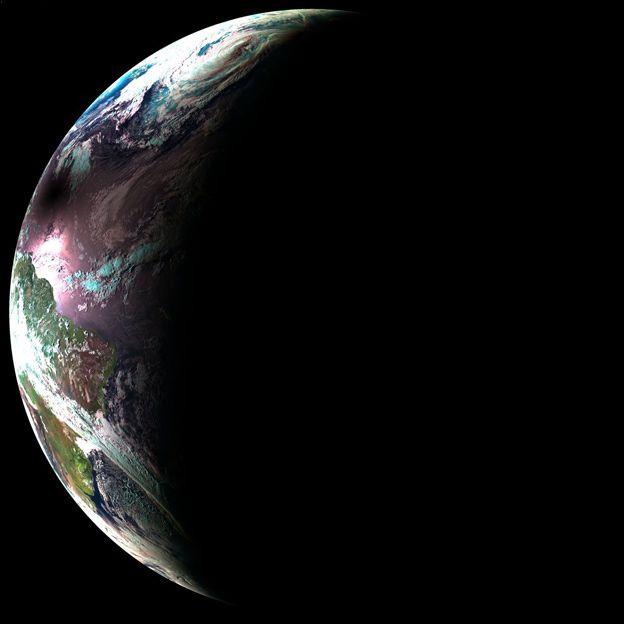
The Moon's shadow (dark spot) leaves the US - as pictured by Europe's Meteosat
|
- As it happened: American eclipse
- The view from above the Pacific Ocean
- When is the next eclipse in my country?
- Why are eclipses so rare?
- Meet the man addicted to eclipses
The spectacle got under way in earnest in Oregon at 10:16 local time (17:16 GMT; 18:16 BST).
Skywatchers
gathered at coastal beaches and towns witnessed the Sun's disc being
completely obscured by the Moon for two minutes.
But just before and just after "totality", they also got to see some of the classic features of a full solar eclipse.
These
included "Baily's beads" which arise as the last shafts of sunlight
drive through valleys on the Moon; and the "Diamond Ring", which is the
single brilliant point of light that signals the beginning and end of
totality.
From Oregon, the eclipse shadow raced on through Idaho,
Montana, Wyoming, Nebraska, Kansas, Iowa, Missouri, Illinois, Kentucky,
Tennessee, Georgia, North Carolina, and South Carolina. It was a journey
that took roughly 90 minutes.
Small towns along the path were inundated with visitors. So were the National Parks. In
Carbondale, Illinois, city authorities billed their locality as the
"Eclipse Crossroads of America" because it would enjoy totality both on
Monday and when the next US eclipse occurs in 2024.
As
anticipated, Carbondale proved to be a huge magnet to skywatchers who
made good use of the more than 60,000 extra car parking spaces organised
for the day.
The area also had the privilege of enjoying the
longest period of darkness anywhere in the country at just over two
minutes and 40 seconds.
The Atlantic coastal city of Charleston was the place tasked with
saying goodbye to the eclipse. Beachgoers experienced the full shadow at
14:48 local time (18:48 GMT; 19:48 BST).
Although, the US had
exclusive rights on totality, a partial eclipse was visible across all
of North America, reaching beyond the Canadian Arctic; as well as across
the north of South America down to Bolivia.
In Washington DC,
President Donald Trump, First Lady Melania Trump and their son, Barron,
made sure they had protective glasses as they looked skyward.
Parts of western Europe were also set to see the Moon take a chunk
out of the Sun at the end of the day just before the star dipped below
the horizon.
It was just a small bite, but in parts of France and
the Canary Islands where clouds were limited - it was no less of a
spectacle.
For those outside the path of the Moon's shadow or smothered by poor weather, there was always the internet.
The US space agency (Nasa) streamed pictures from many vantage points including from a series of helium-filled balloons.
Some of the most spectacular shots of the day came from orbit. Italian astronaut Paolo Nespoli looked down on the moving shadow from the International Space Station.
And
from their "stationary" positions some 36,000km above the planet,
meteorological satellites also returned some stunning imagery.
The next total solar eclipse on Earth is on 2 July, 2019, over the South Pacific, Chile, Argentina.