 |
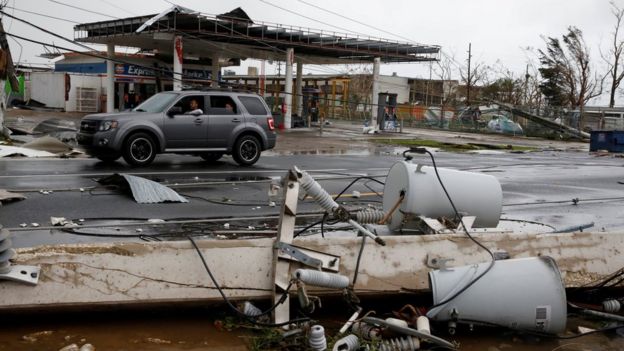
| Hurricane Maria damaged buildings in Puerto Rico and left streets covered in debris |
Hurricane Maria has knocked out power across the island of Puerto Rico, home to 3.5m people, officials have said.
 |
Puerto Rico Governor Ricardo Rossello said one fatality had been reported so far, a man struck by flying debris.
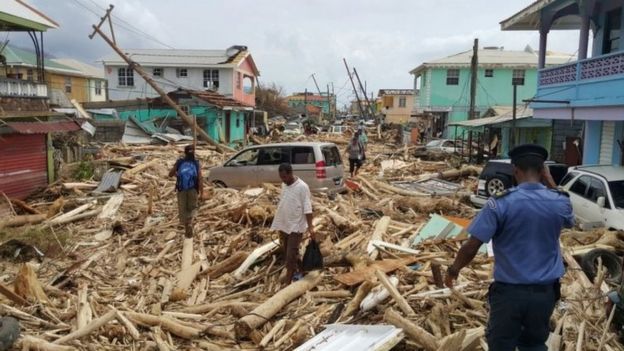 |
| The eye of the hurricane passed directly over Dominica |
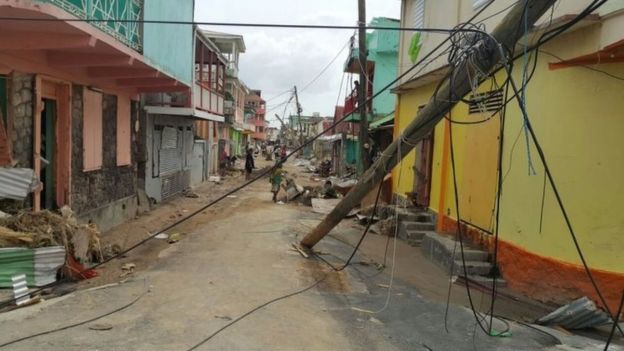 |
| It is taking time for details of the damage in Dominica to emerge |
"When we are able to go outside, we are going to find our island destroyed," Mr Gómez was quoted as saying by the El Nuevo Dia newspaper.
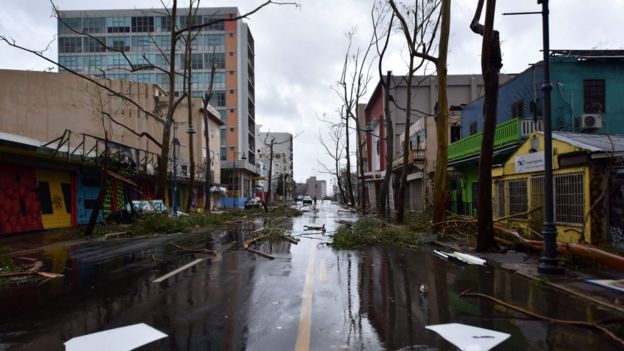
"It's a system that has destroyed everything in its path." Those who emerged from their homes in San Juan after the storm's passing found streets strewn with debris, fallen power lines and shredded trees.
Mr Rossello issued a curfew for 18:00 local time (22:00 GMT) on Wednesday evening through early Saturday morning.
After Hurricane Maria hit Puerto Rico - the biggest storm to make landfall on the island in almost a century - the governor of San Juan has ordered people to stay indoors between 18:00 and 06:00.
In part it is to protect people from accidents with so many electrical cables down and debris in the streets. Furthermore there are thousands of properties empty across the island after people sought refuge with family and friends or in emergency shelters.
Once the winds finally died down enough, residents ventured out to assess the damage. On first impressions, it seems the city has avoided widespread devastation but roofs have been ripped off homes, many trees are down, some balconies have fallen from the front of buildings and I saw at least one building that had completely collapsed near the waterfront.
The real question of how bad Maria has been for Puerto Rico will emerge as news comes in from the more remote regions. Thankfully though, it does seem there has been no major loss of life.
The storm has cut a swathe through the Caribbean on its north-westerly trajectory, hitting the small island of Dominica on Monday night where it left at least seven people dead.
Information on the true extent of the damage is taking time to emerge as communications links were severely hit. It is feared the casualty numbers will rise.
Images from the capital, Roseau, show some streets knee-deep in debris. Footage taken from a plane on Tuesday showed flattened houses and rivers which had burst their banks.
Many buildings have sustained roof damage on the island, which is poorer than many of its Caribbean neighbours. Puerto Rico has asked President Donald Trump to declare the island a disaster area after the storm unleashed heavy flooding and life-threatening winds.
Governor Rossello said major damage was inevitable, although 500 shelters had been established to protect people.
The US National Hurricane Center (NHC) said Maria was projected to pass north of the Dominican Republic on Thursday and then on to the Turks and Caicos Islands and south-eastern Bahamas.
Images shared on social media show roofs being stripped away as winds as strong as 140 mph (225 km/h) whipped trees and power lines in Puerto Rico's capital city, San Juan.
The US territory is facing $73bn (£53bn) in public debt and the damage left by Maria could exacerbate its financial crisis. Declaring a disaster means the island could receive more federal assistance in its recovery.
"God is with us; we are stronger than any hurricane," Mr Rossello said. "Together we will rise again."
Maria made landfall in Yabucoa in the east of Puerto Rico early on Wednesday as a category four storm, according to the NHC. It was the first category four hurricane to directly hit the island since 1932.
Hours earlier, Maria barrelled through the US Virgin Islands' St Croix as a category five storm, sustaining winds of up to 175mph (281km/h).
The French territory of Guadeloupe suffered flooding on Monday and one person was killed by a falling tree and another died on the seafront. At least two others were missing after their ship sank near Desirade, the easternmost island in the archipelago.
Maria is the second devastating storm to hit the Caribbean this hurricane season - the first being category five Irma earlier in September. Maria began moving roughly along the same track as Irma.