 |
Air strikes by the Syrian government
on a rebel-held enclave have continued despite a ceasefire resolution
passed by the UN Security Council on Saturday.
 |
On Sunday, France and Germany called on Russia to put pressure on the Syrian government to honour the ceasefire.
- Life in Eastern Ghouta - read residents' stories
- Syria conflict: Will powers end up in direct war?
- Why is there a war in Syria?
Speaking to Russian President Vladimir Putin in a joint telephone conversation, German Chancellor Angela Merkel and French President Emmanuel Macron have asked for help with implementing the UN resolution.
The UN resolution was agreed to allow for aid deliveries and medical evacuations, but operations against the biggest jihadist rebel groups are not covered by the truce.
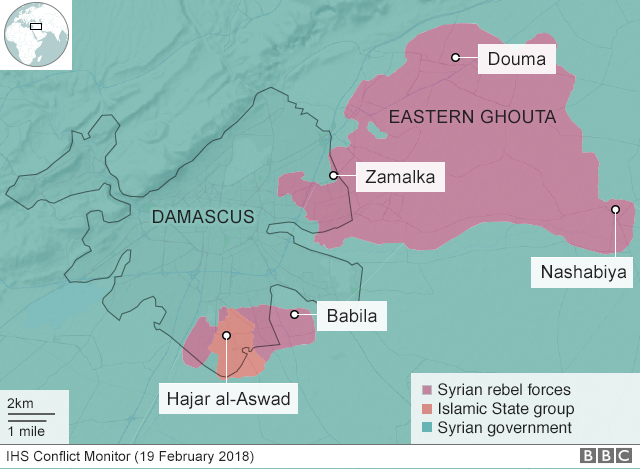
The region is the last major rebel-held area near the capital Damascus.
What happened on Sunday?
Government air strikes took place in the rebel enclave soon after the resolution was agreed in New York, although at far lower level than in previous days.At least three people are reported to have died in the latest attacks, while one rebel group in the Eastern Ghouta said it had killed a number of government soldiers.
The Syrian American Medical Society, a relief organisation, told the BBC that one of its hospitals in the area has received patients suffering from symptoms that indicate a chemical attack. It said one child has died.
The Syrian Observatory for Human Rights (SOHR), a UK-based monitoring group, said it has received similar information, but has not yet been able to confirm if there was a gas attack.
The strikes targeted the outskirts of Douma, the main town in the Eastern Ghouta, according to the SOHR.
It also reported several casualties on both sides after Syrian government forces clashed with rebels in southern areas of the enclave.
Syrian forces on the ground are pushing to enter the Eastern Ghouta, both opposition and pro-government sources said on Sunday.
The government has been trying to advance on several fronts but its forces have so far been repelled, rebel groups say.
Meanwhile, Iran said that while it would "adhere" to the ceasefire, it would continue its military operations in areas around Damascus that were not covered, Reuters news agency reports.
"Parts of the suburbs of Damascus, which are specifically controlled by the terrorists of the Nusra Front and other terrorist groups, are not subject to ceasefire," Iran's military chief of staff, Maj Gen Mohammad Baqeri, is quoted as saying.
Iran, along with Russia, is a key supporter of Syrian President Bashar al-Assad and has played a vital role in enabling him to recapture territory across the country.