 |
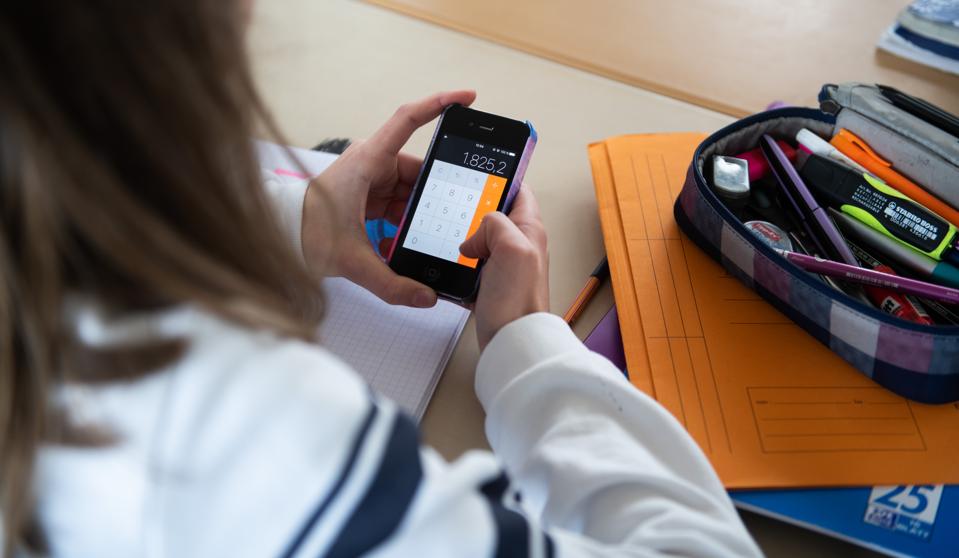
| A fifth grade student of a grammar school uses the calculation function of her smartphone. |
My mind drifted to my own science fair and exploration years as a kid. I used to catch insects and keep them in jars just to see what would happen to them.
 |
I cherished going down to the nearby creek at North Canton Elementary School to forage for minnows or crawfish. As an only child, I remember spending countless hours reading World Book Encyclopedia just because the volumes were in the house.
I also remember asking my mother to take me to the public library to get books about weather, Dr. George Washing Carver, or airplanes. I didn’t know the fancy terminology then, but I am pretty sure it was inquiry-based learning and research.
As the father of two bright kids in high school and middle school respectively, I keep a close eye on their science learning. They both have very strong aptitude and do well in science, but I often wonder if their generation as a whole is “missing something” in this “Google it-What does Wikipedia say-Gaming” era.
To be clear, I am not one of these old, nostalgic adults that automatically presumes that things from “the good ole” days are better (Ok, maybe on the music but I digress).
In fact, it actually annoys me when I hear people complain about modern advances and resources. I like technology and modern advances.
Herein, I explore the state of science education from the lens of my own experiences. I offer the following disclaimer: Though a professor at the University of Georgia and a former NASA scientist, I am not a science education expert. Neither of those credentials suggests that I know more about methodology, latest scholarly research, or pedagogy of science education.
As a climate scientist, I get my share of “opinions” and “non-rigorous theories” from random people on that topic. This essay simply offers my perspectives, but I do defer to two science experts as well.